

Pronto.AI, an AHS provider, and Whittle Consulting partnered with Amalgama Software Design to evaluate whether smaller autonomous trucks could outperform larger manned trucks economically and operationally.
Challenge
The traditional approach to LOM calculations uses linear estimations of mining rates that do not consider the following:
- Queuing of trucks at excavators due to truck-and-shovel pairing
- Queuing of trucks at dumping points due to congestion
- Decrease of haulage speed due to human factors such as breaks and uneven truck speed
Since this study required an accurate representation of the impact of these factors due to changes in fleet size and composition, a more detailed approach was needed. Whittle Consulting approached Amalgama Software Design to use their MineTwin simulation tool to consider these factors and determine the most optimal trucks and shovel fleet configuration. We tested various fleet configurations on three stages of mining:
- shallow pit (20-68 meters deep),
- medium pit (116-196 meters deep), and
- deep pit (244-324 meters deep).
Why MineTwin
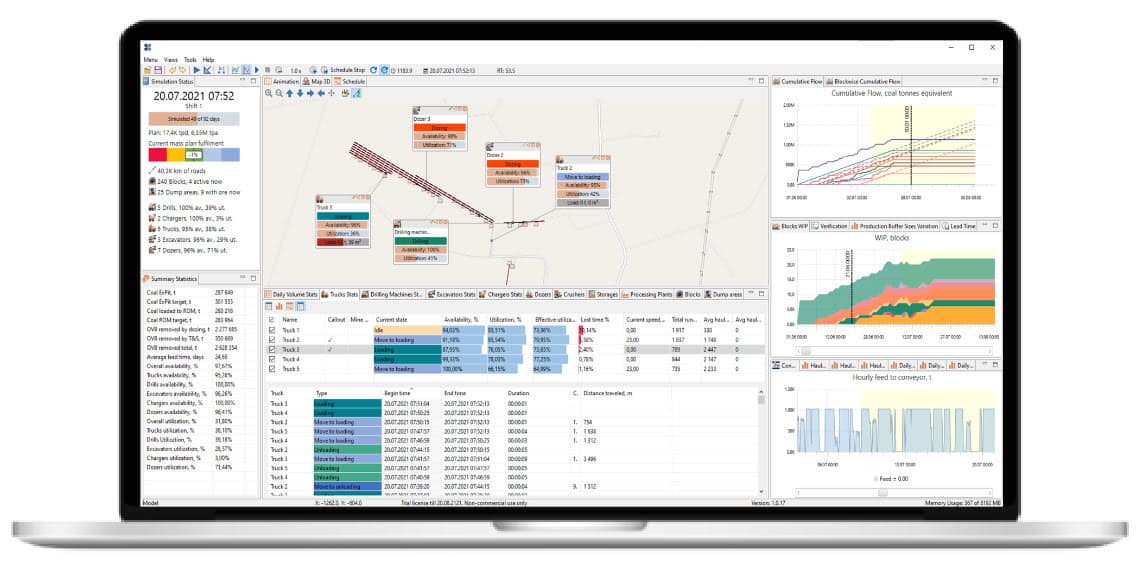
MineTwin is a simulation tool designed specifically for mining operations. It allows detailed simulation of truck–loader interactions, queuing, haulage delays, and stoppages.
It supports fast, flexible testing of fleet and scheduling scenarios, helping mine planners and top management make informed decisions based on realistic operational behavior.
Solution
Created a base case mining operation scenario comprised a North American setting, a simple resource model, a three-phase open pit, a site road network, and a processing plant.
Created 9 scenarios, 3 for each mining stage, with pit vertical distance ranging from 10 to 324 meters.
For every scenario, we varied the number of trucks and excavators. 924 MineTwin simulation experiments were conducted on a server in automated mode.
NPV Scenario Analysis
The base case mining operation comprised a North American setting, a simple resource model, a three-phase open pit, a site road network and a processing plant.
For each scenario, we identified the optimal combination of trucks and shovels that minimized time losses due to queuing and congestion, while keeping to the target tons output. The optimal fleet size was then used in the LOM calculations, and the following results were observed.
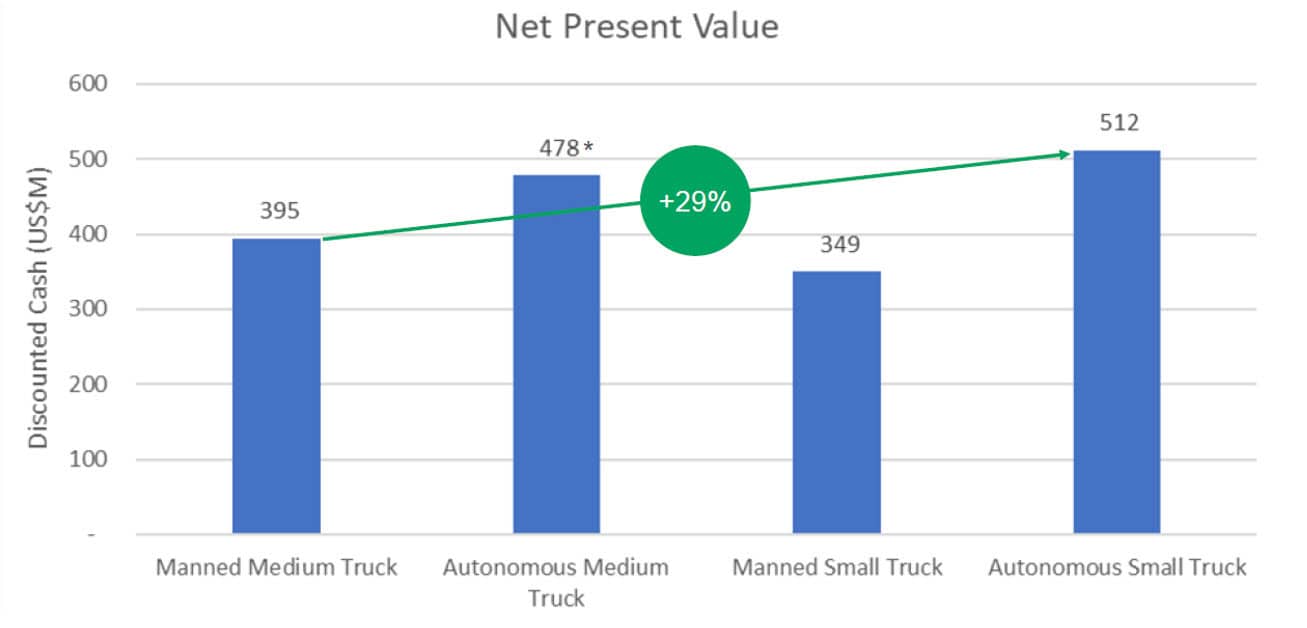
Scenario 1 (baseline): The baseline scenario with human-driven 100-ton trucks provided the reference point for NPV comparison.
Scenario 2 (autonomous 100-ton Trucks): Implementing autonomy in 100-ton trucks resulted in a 23% increase in NPV. The improvement was driven by higher truck utilization and reduced labor costs.
Scenario 3 (human-driven 40-ton Trucks): Using smaller trucks without autonomy led to a decrease in NPV by 9%, largely due to increased labor costs and congestion, which offset the lower capital and maintenance costs.
Scenario 4 (autonomous 40-ton Trucks): This scenario produced the highest NPV, with a 31% increase over the baseline. The autonomy significantly reduced labor costs, improved haul speeds, and minimized congestion, making smaller trucks economically viable.
Fleet Composition Analysis
MineTwin was used to test 924 fleet scenarios across varying pit depths, identifying truck–excavator combinations that met haul targets while minimizing queuing and delays. Results showed optimal fleet sizes differed by depth and truck type, emphasizing the need for simulation in fleet planning.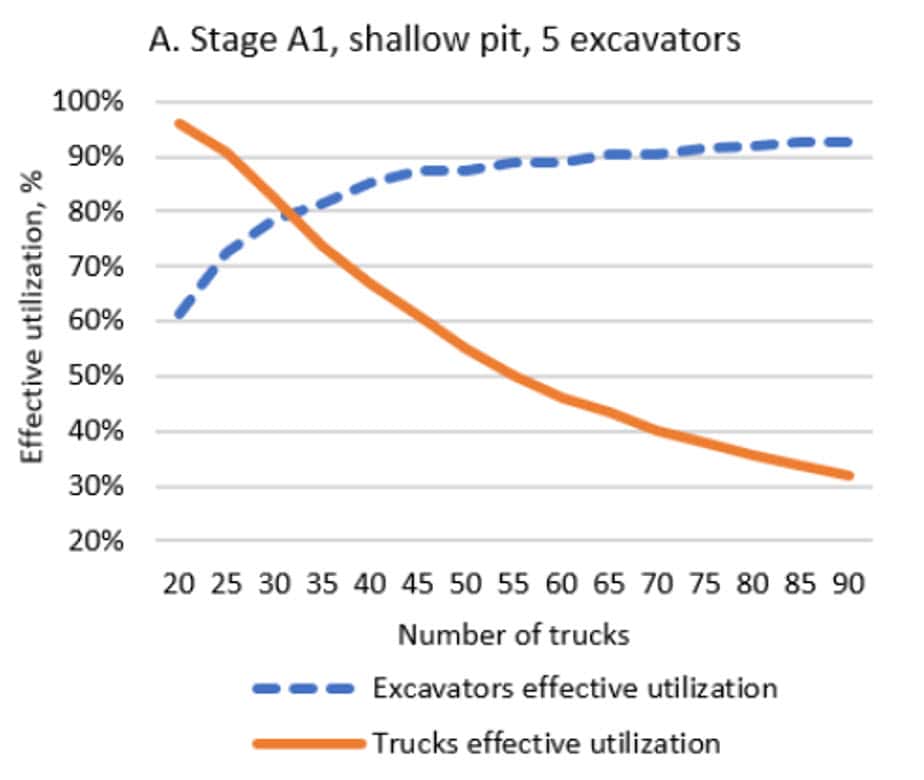
Benefits
Proved that using autonomous 40-ton trucks improved the mine’s NPV by 31% compared to human-driven 100-ton trucks and by 7% over autonomous 100-ton trucks.
Proved significant potential for cost optimizing of surface mining operations using autonomous haulage systems based on smaller vocational trucks.
Clients
 Pronto.AI – provider of off-road autonomous haulage systems for rugged and remote mining environments.
 Whittle Consulting – specialists in integrated strategic mine planning and value chain optimization for mining projects.
Download a PDF of this case study: MineTwin Pronto Case Study
Learn more about MineTwin.
Contact MOSIMTEC to learn more about how simulation modeling can help your organization.