
Why Mining Equipment Maintenance Matters
Mining equipment maintenance plays a critical role in ensuring that equipment operates efficiently, safely and with minimal downtime. Mining operations rely heavily on a wide range of machinery and equipment. From haul trucks to shovels and loaders, these powerful machines must perform consistently under the harshest conditions. Without a strong maintenance strategy, mining companies face higher operational costs, unexpected breakdowns, and even safety risks.
Causes of Equipment Downtime in Mining Operations
In addition to downtime due to planned or schedule maintenance, mining equipment can go down due to random failures. These can be caused by regular wear & tear, improper maintenance, operational errors, corrosion & rust or just mechanical fatigue.
The general goal of maintenance supervisors and mine managers to reduce any unexpected failures in their operations. Their intuition is to ensure all equipment have thorough maintenance plans that need to be executed religiously. In other words, reducing failure for all equipment is equally important. However, maintenance budgets are not unlimited and depending on the business cycle (sometimes driven by commodity prices), mine managers have to be make hard choices on which equipment requires more maintenance than others.
How to Prioritize Maintenance Across Equipment Types
Should we perform maintenance on crushers first before we fix haul trucks? Do we pay special attention to loaders over conveyors? The decision to determine which equipment requires maintenance over another gets even tricker when they interact with each other. For example, in an open pit operation, we usually have a shovel in a pit or at the face, scooping ore and loading trucks. There is a queue of trucks that need to be constantly fed. Trucks queue up for shovel to load and shovel waits for trucks to show up at the spotting location. This interaction is similar to that of the mucker and the truck in the underground mining operation. The video below illustrates the inter-play between material handling equipment.
 Figure 1 – Example of Shove & Haul truck interaction in open-pit mining
Loader vs. Truck Downtime – Which Hurts More?
Our intuition tells us that downtimes of different equipment should have a different impact on the overall throughput of mine i.e. tons transported. But how can we quantify the impact? One way to quantify the importance of downtime between one set of equipment over another is to simulate it!
Using MineTwin to Simulate Equipment Failures
To help us quantify where maintenance OPEX needs to focused on, we use MineTwin, a software platform for simulation and planning of mining operations developed by Amalgama. We are using the Underground edition that allows us to drag-and-drop from the palette. We will design a simple system a Cross Dock Point (CDP) which will be a loading location like a muck-bay within the UG, a road network for trucks to travel on and a destination Ore Pass (OP) where ore will be deposited. A Loader equipment instance will be available at the cross dock point (CDP) to load ore onto trucks. There are 5 truck instances of the same type that transport ore from the cross dock point to the ore pass until all ore has been transferred. The model will have a 1M tons of ore (just for illustration purposes…cause that’s unrealistic!) available to muck at the CDP. Based on our intuition, since we just have one Loader in the system, it will be the bottleneck and its failure profile will stop everything else.
Our goal is to quantify the impact of unplanned failures on the loader and trucks. The occurrence of unplanned failures will be our proxy for good or bad maintenance strategies. We will have one probability distribution for the random time between failures (mean time between failures or MTBF) and another one for time to repair (mean time to repair or MTTR) the equipment. In the real world, these probability distributions, also referred to as failure profiles, vary by equipment type, vendor, model number, age and usage. Sometimes, there are usually multiple failure profiles on a single piece of equipment for different parts e.g. for a loader, there may be one failure for the bucket vs. the powertrain vs. the hydraulics system. For simplicity’s sake, we will lump all failure types for an equipment into a single failure profile. Moreover, we will use the same failure profile for both loaders and trucks to MTBF of triangular (min=50, mode=75, max=100) hours and MTTR to triangular (min=5, mode=10, max=15) hours.
We test this simple haulage model under 4 scenarios: no failures, loader failing only, truck failing only and both loader & truck failure periodically.
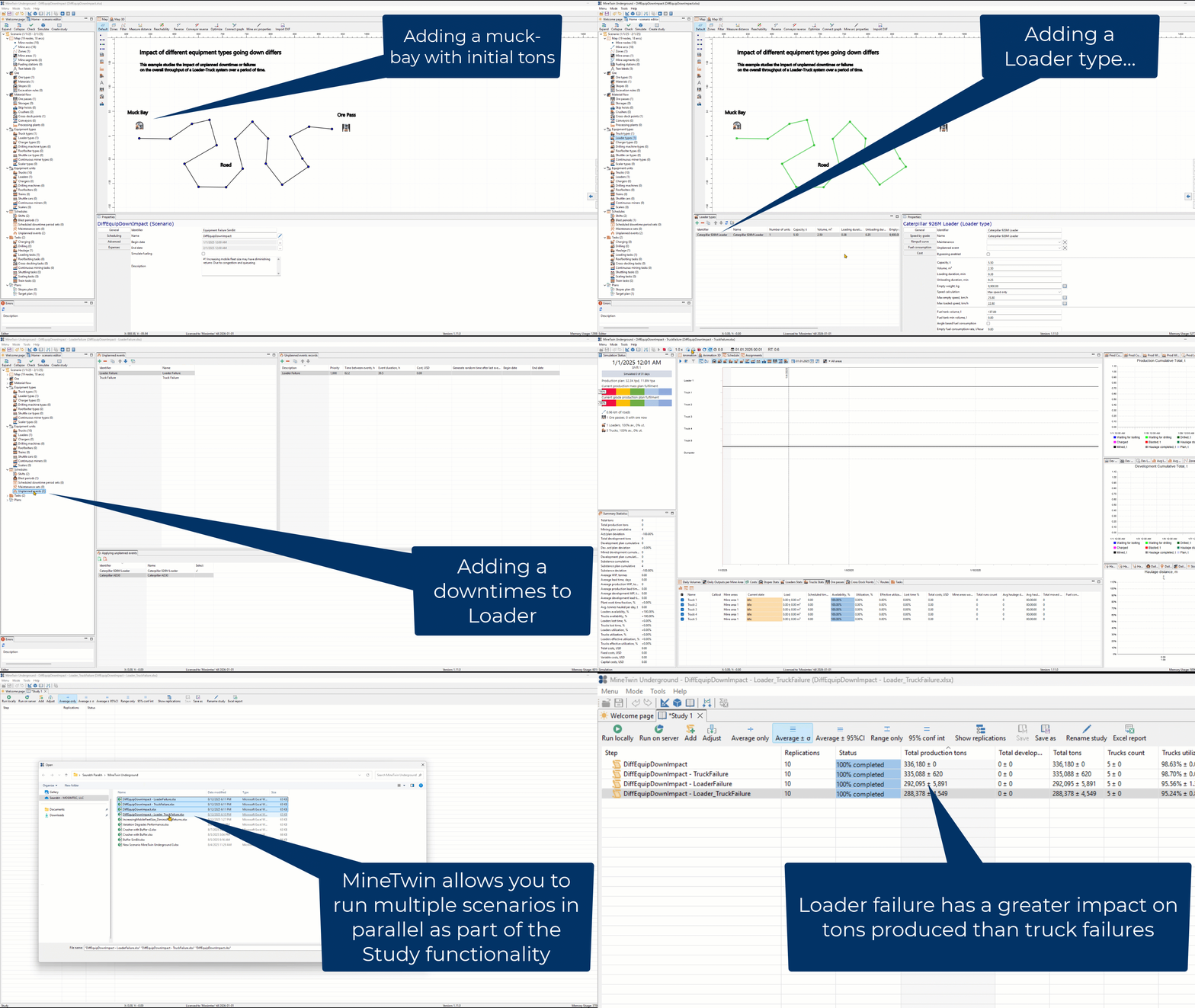
Figure 2 – Failure scenarios illustrated in MineTwin
Key Findings from Our Simulation Study
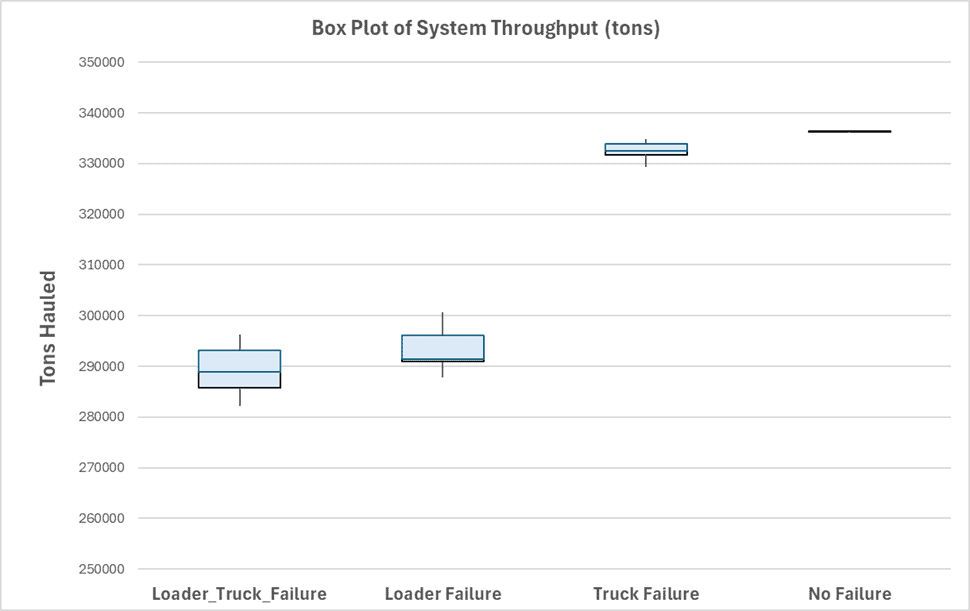
Our MineTwin Study comprises of 4 scenarios with 10 replications for each scenario run over a simulation run duration of a month.

With our simple model, we can quantify the importance of Loader in our system. Failure of trucks periodically in our system only reduces throughput by 1% but failure of the loader (our bottleneck) reduces throughput by about 13%.
Final Thoughts and Next Steps
In summary, we will get a bigger ROI of conducting scheduled maintenance and ensuring our loaders don’t have planned failures. We can test many variants of this system using MineTwin by changing the number of trucks and loaders, testing different travel distances and testing assumptions about relationship between maintenance and failures in a mining operation.
Contact MOSIMTEC to see how MineTwin can optimize your mining maintenance strategy.
FAQ
- What causes mining equipment downtime?
- Which equipment failures impact mining productivity most?
- How can simulation help in mining maintenance planning?