
MOSIMTEC has built hundreds of simulation models over the years to test various aspects of systems during the conceptual and design phases. A particularly important use-case for simulation is during the Sales phase. When selling industrial material handling equipment, one of the most common questions from customers is simple: “How fast can we load trucks?”
But the real answer is rarely just about the loader itself. In most bulk loading operations, overall throughput is determined by the interaction between trucks, forklifts, and the loading equipment. A high-capacity loader may not increase throughput if trucks arrive too slowly or if forklifts cannot supply material fast enough. This is where simulation modeling becomes a powerful sales tool. Instead of relying on assumptions or static calculations, simulation can demonstrate how a complete loading operation behaves under different conditions — revealing where the real bottleneck is likely to occur.
Understanding a Typical Bulk Truck Loading Operation
A common configuration for bulk loading systems uses forklifts to deliver large bags of material to a mobile loading system, which then transfers the material into tanker trucks.
Systems like the Polimak Mobile Bulk Truck Loading Systems typically include:
- A big bag discharge station
- A screw conveyor that moves material to the truck
- A telescopic loading chute
- A dust collection system
- A mobile chassis for flexible positioning
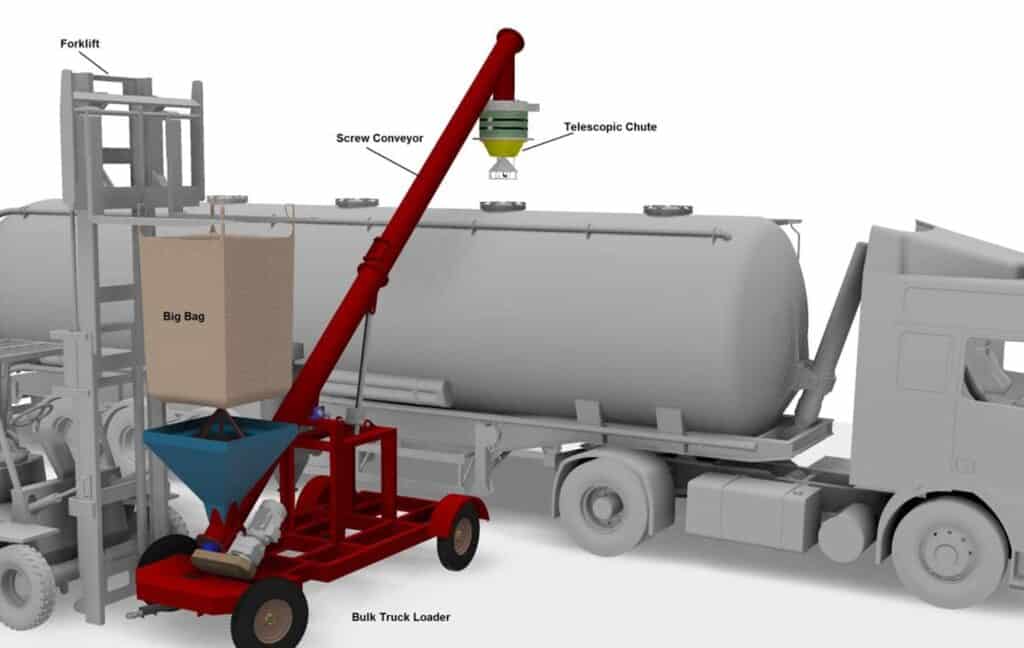
Example of forklift unloading bag into a bulk truck loading system (Image credit https://polimak.com/en/)
These systems allow efficient and dust-free loading of powders and granular materials such as cement, minerals, plastic pellets, or agricultural products. In a typical operation:
- A forklift delivers a bulk bag to the loader.
- The bag is discharged into a hopper.
- Material moves via screw conveyor to the loading chute.
- The chute feeds material into the truck until it is full.
The equipment itself can move material quickly — some systems can empty a bulk bag in roughly 1.5–2 minutes. However, the overall loading rate of the site depends on more than just the conveyor capacity.
The Hidden Problem: System Bottlenecks
In practice, three resources compete to determine throughput:
- Forklifts delivering material
- The loader transferring material into trucks
- Trucks arriving and departing
The slowest of these becomes the bottleneck. For example:
| Scenario | Bottleneck |
| Too few forklifts | Loader sits idle waiting for material |
| Slow loader | Trucks queue up waiting to be filled |
| Too few trucks | Loader and forklifts sit idle |
Without a system view, it’s easy to oversize equipment or invest in the wrong part of the process.
Why Simulation Is Ideal for This Problem
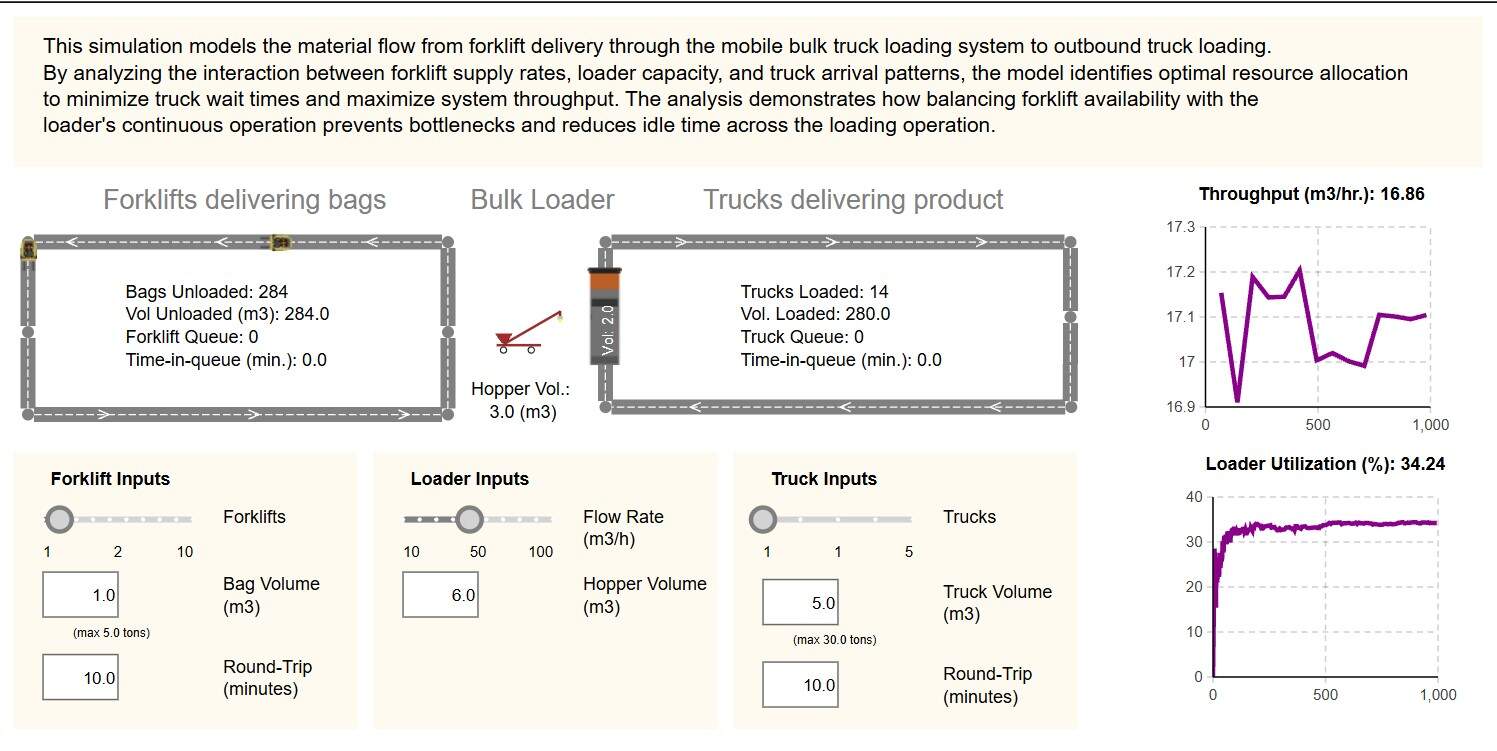
Simulation modeling allows engineers and sales teams to recreate the entire truck loading operation digitally. In a simple simulation model, we can allow users to adjust key parameters such as:
- Number of forklifts
- Number of trucks
- Forklift round-trip travel time
- Truck cycle time
- Loader flow rate
The model then simulates the operation over time and measures Truck queue length, Loader utilization, Forklift utilization, Overall throughput and Waiting times. Because simulation captures dynamic interactions, it reveals behaviors that are difficult to predict using spreadsheets.
How the Bottleneck Moves
One of the most powerful insights simulation provides is showing how the system bottleneck shifts when parameters change.
| Case 1: Loader Bottleneck
If the loader capacity is low relative to truck arrivals:
The obvious solution may be a higher-capacity loading system. |
Case 2: Forklift Bottleneck
If forklift travel times are long or too few forklifts are available:
In this case, buying a larger loader would not improve throughput at all. The better solution might be:
|
Case 3: Truck Bottleneck
If trucks arrive infrequently:
Here, the equipment is not the limiting factor. |
Why This Matters for Equipment Sales
Simulation transforms the sales conversation. Instead of asking: “What capacity loader do you need?”
You can show customers: “Here is how your entire operation will perform.”
The result is:
- Higher customer confidence
- Customers see a data-driven justification for equipment selection.
- Right-sized equipment – Simulation prevents both:
- Undersizing equipment
- Overpaying for capacity that won’t be used
- Faster purchasing decisions
- When customers can visualize operations and throughput, the discussion becomes objective rather than speculative.
Interactive Simulation: A New Way to Sell Industrial Equipment
Imagine a simple interactive tool where a customer can adjust sliders for:
- Number of forklifts
- Number of trucks
- Loader capacity
- Travel times
Within seconds they see:
- Truck queues forming
- Idle forklifts
- Loader utilization changing
Suddenly, the system behavior becomes obvious. Simulation turns equipment sales from spec sheets into operational insight.
The simulation allows you to adjust several system conditions, such as number of forklifts and trucks, their travel times, and loader performance. You can also adjust these inputs as the simulation runs to understand its effect on system throughput and loader utilization. Run the model by hitting the play button and watch the animation of forklifts and trucks moving product.
Interactive Simulation Model (Image credit https://polimak.com/en/)
The Future: Simulation-Driven Equipment Design
The most forward-thinking equipment suppliers are beginning to combine engineering, data, and simulation to support customers earlier in the design process. Instead of simply providing machines, they are helping customers design entire material handling systems.
For bulk loading operations, this means answering questions like:
- How many trucks should operate per shift?
- How many forklifts are required?
- What loader capacity is optimal?
- What happens if demand doubles?
Simulation provides these answers before any equipment is installed.
Bottom line
The fastest loader does not always create the fastest system. By simulating the interaction between forklifts, loaders, and trucks, companies can identify the true bottleneck and design the most efficient bulk loading operation.