
 The objective of this study was to validate the technical design decisions and assess mine performance at years 1, 7, 15, and 25 of operation.
Tasks included:
- Accounting for equipment downtime caused by weather conditions
- Evaluating the efficiency of a conveyor-truck hybrid haulage system
- Determining the optimal equipment fleet (including tailings transport from the processing plant)
Project Context
The project simulated the mine’s operation and processing plant for multiple stages (years 1, 7, 15, 25).
Each stage included:
- Comparison of overburden haulage options: trucks, conveyor-based haulage, or a combined system
- Consideration of seasonal effects (low temperatures) causing downtime and reduced productivity
- Validation of engineering design and fleet sizing based on performance and availability criteria
- Scenario-based analysis using discrete-event simulation and interpretation of results
Additionally:
Integration with the geological information system automated block creation for ore and waste, accelerating scenario preparation.
Key Questions
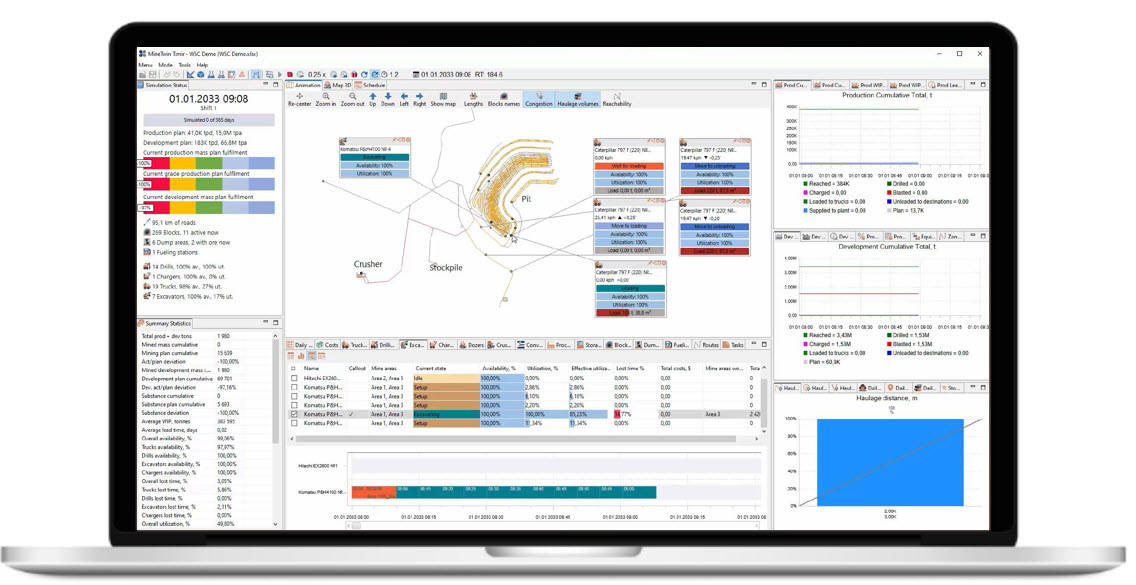
Modeling with MineTwin was used to answer:
- Are the design assumptions for the plant and fleet valid?
- What fleet configuration is optimal for achieving ore and waste targets?
- How many bulldozers are required for dumps, cleaning, and ore stockpiles?
- When does the conveyor-based haulage system become economically justified?
- What is more efficient — conveyor or truck transport of tailings?
- How does weather affect mining productivity?
Solution
Simulation scenarios were developed for key stages of life of mine.
The model accounted for:
- Seasonality of equipment units’ downtimes
- Transportation of tailings from the processing plant
Performed scenario analysis (CAPEX, OPEX).
Integration with the mine’s geological information system enabled automated scenario setup.
Results
- The project layout was updated — the processing plant was relocated closer to the pit.
- Haulage technologies for ore and waste were compared.
- Optimal fleet sizes were determined, and production bottlenecks were identified.
Quantitative Effects:
- Adding one 20 m³ shovel increased production by +1.48 Mt of ore and +2.3 Mt of waste.
- Optimized bulldozer fleet: 8 instead of 9 (saving ≈ USD 300–400K).
- A conveyor system for tailings transportation proved to be over 2 times more efficient than 130-t trucks.
Fleet Calculations
Bulldozer fleet optimization:
Optimal: 8 instead of 9 units → saving USD 300-400K
Confirmed requirement: 10 units at 260–300 t/h productivity
Excavator fleet (year 7):
Adding one 20 m³ shovel →
- +1.48 Mt ore,
- +2.3 Mt overburden
Plant-Related Findings
- The conveyor system for tailings transport was more than twice as efficient as 130-t trucks.
- Simulation confirmed the need to relocate the processing plant closer to the pit to reduce haul distance and improve profitability.
Why MineTwin
Designed specifically for mining:
Unlike general-purpose tools, MineTwin accurately reproduces both open-pit and underground operations.
It models detailed equipment interactions, including cyclic-continuous haulage systems, capturing nonlinear constraints and dependencies invisible in Excel or linear programming.
Bridging strategic planning and operations:
MineTwin validates plan feasibility while considering equipment availability, geological conditions, and operational constraints.
Scalable and adaptable:
It enables creation of an internal competence center capable of building models for multiple mines on a single platform.
MineTwin is flexible enough to adapt to different mine layouts and process configurations.
After implementation, internal teams can independently perform scenario analyses, fleet optimization, and operational assessments — supporting continuous improvement and data-driven investment decisions.
Download a PDF of this case study: MineTwin OpenPit Strategic Planning Case Study EN_MOSIMTEC
Learn more about MineTwin.
Contact MOSIMTEC to learn more about how simulation modeling can help your organization.